RWS & OEKO-TEX Certified 美利奴羊毛 & 户外徒步保暖袜

Custom Merino Wool & Thermal Outdoor Socks

Crafted with RWS (Responsible Wool Standard) certified fine Australian merino wool. Delivers superb natural moisture wicking, active thermoregulation, and zero-itch comfort. Engineered with reinforced Cordura nylon heels and toes, full loopback terry cushioning, smooth-toe hand linking, and ergonomic over-the-calf or boot heights for extreme alpine and work conditions.

Equipment & Technology Heavy-Gauge Terry Machines, Rosso Smooth-Toe Linkers & Multi-Feed Wool Units
Available Needle Gauges 96N Chunky, 120N Heavy Terry, 144N Precision Trail
Monthly Production Output 250,000+ Pairs
Core Styles:
Merino Wool Knee High SocksMerino Wool Over the Calf SocksMerino Wool Blend Boot SocksSki Socks Merino WoolOver the Knee Merino Wool SocksPossum and Merino Wool SocksMens Smoothtoe Predator SocksWomen's Merino Wool Knee High SocksThick Full Cushion Boot Socks
Applications:
Ski & Snowboard Specialty RetailersAlpine Mountaineering & Backpacking BrandsHunting, Tactical & Outdoor Gear LabelsCold Weather Work Boot & Heavy Duty WearNordic, Alaskan & Antarctic Exporters
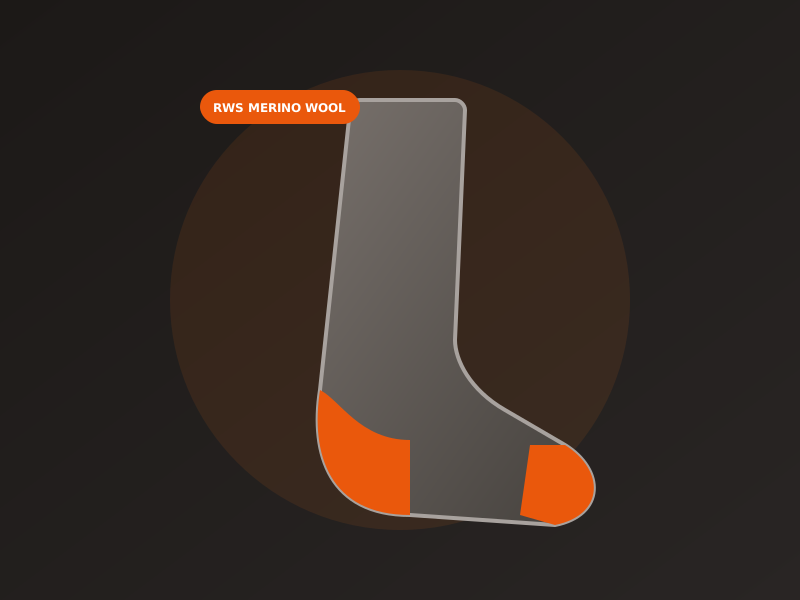
Heavy Cushion Australian Merino Wool Outdoor Hiking Socks
120N BESTSELLER

Heavy Cushion Australian Merino Wool Outdoor Hiking Socks

RWS certified fine Australian Merino wool trekking socks with full terry loopback warmth, blister prevention, and moisture regulation.

Needle Gauge: 120N Heavy Cushion Wool
Cushioning: Full Heavy Loopback Terry Footbed & Shin Padding
Min MOQ: 500 Pairs
FOB Price: $2.20 - $8.80 / pr
  • Natural Thermoregulation — Warm in Winter, Cool in Summer
  • Natural Odor Resistance for Multi-Day Wear
  • Cordura Nylon Reinforced Heel & Toe for Abrasion Resistance
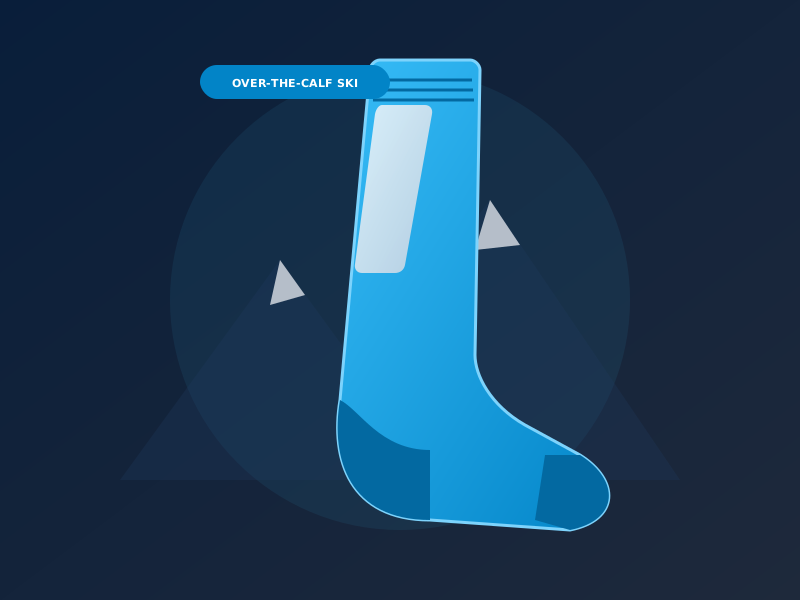
Over-the-Calf Merino Wool Ski & Snowboard Knee High Socks
144N BESTSELLER

Over-the-Calf Merino Wool Ski & Snowboard Knee High Socks

Over-the-calf (OTC) knee high merino wool ski socks with targeted shin cushioning or ultra-thin zero cushion ski socks options, graduated elastic compression, and thermal vapor channels. Benchmarked to Yuedge socks performance.

Needle Gauge: 144N Precision Ski
Cushioning: Targeted Shin Guard or Zero Cushion Ski Socks Profile
Min MOQ: 500 Pairs
FOB Price: $2.80 - $9.50 / pr
  • Over-the-Calf Knee High Height Stays Up All Day in Ski Boots
  • Engineered Shin Cushioning Absorbs High Impact & Prevents Boot Bite
  • Optional Zero Cushion Ski Socks Construction for Precision Racing Shells
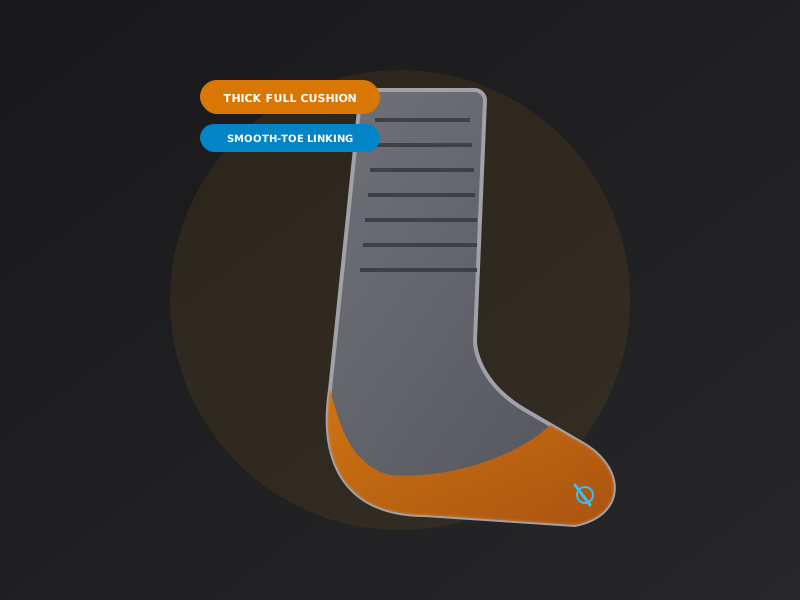
Men's Smooth-Toe Thick Full Cushion Merino Wool Blend Boot Socks
120N BESTSELLER

Men's Smooth-Toe Thick Full Cushion Merino Wool Blend Boot Socks

Heavy-duty 120N merino boot socks and merino wool blend boot socks with hand-linked smooth toe closure, thick full cushion terry sole, and reinforced Cordura heel. Private label benchmark quality for Jefferies socks merino wool thick full cushion boot socks styles.

Needle Gauge: 120N Heavy Terry Boot
Cushioning: Thick Full Heavy Terry Throughout Sole & Leg
Min MOQ: 500 Pairs
FOB Price: $2.50 - $8.90 / pr
  • Engineered to meet and exceed Jefferies socks merino wool thick full cushion boot socks specifications
  • Heavy-Duty Merino Boot Socks Structure Keeps Feet Insulated Down to Sub-Zero Cold
  • Cordura Reinforced Heel & Toe Resists Holes Eliminating Need for a Darning Mushroom for Socks
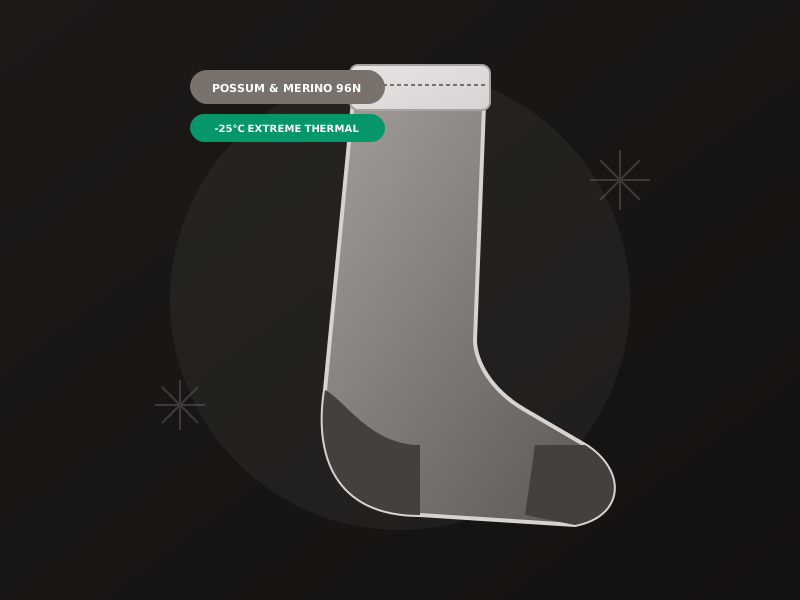
Luxury Possum Fur & Merino Wool Blend Extreme Cold Socks
96N BESTSELLER

Luxury Possum Fur & Merino Wool Blend Extreme Cold Socks

Ultra-warm hollow-fiber New Zealand possum fur and fine merino wool blend thermal socks for arctic conditions down to -25°C.

Needle Gauge: 96N Chunky Thermal
Cushioning: High-Loft Dual Layer Brushed Terry Footbed
Min MOQ: 500 Pairs
FOB Price: $4.50 - $14.80 / pr
  • Hollow-Fiber Possum Down Traps 55% More Air for Superior Thermal Rating
  • Ultra-Lightweight Yet Substantially Warmer than 100% Heavy Sheep Wool
  • Pill-Resistant Fine Merino Matrix Extends Garment Life Cycle
Performance Science

Merino Wool Socks vs Cotton: Technical Performance Breakdown

Why performance outdoor brands, ski gear retailers, and work boot manufacturers choose Merino wool over cotton.

Technical Property RWS Certified RWS Merino Wool Performance Traditional Cotton Socks OEM Buyer & Wearer Advantage
Moisture Absorption & Wicking Absorbs up to 30%–35% of its dry weight in moisture vapor without feeling damp; pulls sweat away from skin. Absorbs 7%–8% moisture, quickly saturates, collapses, and stays wet against the skin. Merino keeps feet dry during strenuous activity
Thermal Insulation When Wet Natural crimp in wool fibers traps millions of tiny air pockets. Retains up to 80% insulating loft even when soaked. Loses 100% of its insulating loft when wet, causing rapid conductive heat loss and chilling. Merino prevents hypothermia & cold injury
Blister & Friction Prevention Keratin protein fibers stay smooth and pliable under pressure; hand-linked smooth-toe eliminates toe seam friction. Fibers swell, stiffen, and create abrasive shear against the skin when sweaty, leading directly to blisters. Superior foot comfort in tight boots
Odor Control & Antimicrobial Longevity Natural lanolin and complex fiber chemistry trap odor molecules and naturally resist bacteria for multi-day expeditions. Provides a moist breeding ground for bacteria and fungi, requiring immediate washing after single use. Multi-day wearability with zero stench
Elastic Memory & Boot Staying Power When core-spun with Lycra and Cordura nylon, Merino fibers rebound naturally without sagging or bunching inside boots. Stretches out and sags down the leg under sweat and heavy boot friction. Zero slouching in knee-high & boot heights
Height & Fit Taxonomy

Custom Merino Sock Heights: Knee-High, Boot & Crew Architecture

We knit precise graduated heights to match ski boots, 8-inch tactical boots, mountaineering footwear, and lifestyle sneakers.

14" – 16" (35 – 40 cm)

Merino Wool Over the Calf Socks / Knee-High

Best Applications:

Skiing, Snowboarding, Hunting, Winter Sports

Engineering Specs:

Targeted shin impact pads, non-slip wide rib cuff, graduated calf compression for blood return.

18" – 22" (45 – 55 cm)

Over the Knee Merino Wool Socks (OTK)

Best Applications:

High-Altitude Mountaineering, Arctic Cabin Wear, Fashion Boots

Engineering Specs:

Extended thigh coverage, stay-put elastic band, ultra-warm double-layer terry knitting.

10" – 12" (25 – 30 cm)

Merino Wool Blend Boot Socks

Best Applications:

Work Boots, Field Sports, Logging & Tactical Footwear

Engineering Specs:

Thick full cushion loopback terry sole and leg, Cordura abrasion heel/toe, smooth-toe linking.

7" – 8" (18 – 20 cm)

Technical Trail Crew

Best Applications:

Hiking, Backpacking, 3-Season Trekking

Engineering Specs:

Arch band compression, instep breathable mesh vent, blister-resistant Achilles cushion tab.

Precision Craftsmanship

Engineered For Extreme Durability & Blister Prevention

High-precision Chinese manufacturing combining certified Australian wool with specialized Italian linking.

Zero Friction

Hand-Linked Smooth-Toe Seam

100% flat stitch-by-stitch closure eliminates toe seam ridges. Crucial for mens smoothtoe predator merino wool knee high socks and steel-toe work footwear where friction causes blisters.

Max Thermal Cushion

Thick Full Cushion Loop Terry

High-density 120N terry loops wrap the entire footbed, heel, and ankle bone to cushion high impacts, absorb vibrations, and lock in body heat.

Hollow Fiber Tech

Possum Fur & Merino Luxury Blends

New Zealand possum down hollow fibers blended with fine 18.5µm Merino wool trap 55% more air, giving extreme sub-zero warmth down to -25°C at 30% lighter weight.

3x Wear Life

Cordura® Heel & Toe Reinforcement

Military-grade high-tenacity nylon plated alongside wool yarn in high-wear friction zones, tripling the abrasion lifespan against rugged boot interiors.

Engineering Deep-Dive

Technical Hosiery Engineering & Material Science

A rigorous analysis of fiber mechanics, core-spun plating architecture, and precision finishing standards for high-performance merino wool & thermal outdoor socks.

Chapter 01 // Material Science

Fiber Physics & Micron Grading: The Mechanics of Non-Itch Next-to-Skin Comfort

Epidermal prickle sensation in wool hosiery is not an allergic reaction, but a predictable mechanical consequence of fiber rigidity. By engineering socks exclusively with 17.5µm to 19.5µm Australian Merino wool, Kangyi achieves cashmere-soft contact while maximizing moisture thermodynamics.

In traditional hosiery, coarse sheep wool above 24 micrometers in diameter possesses substantial column buckling strength. When these thick fiber ends press perpendicularly against the wearer’s skin inside a locked boot cuff, they fail to bend under standard contact force (approx. 75 milligrams). Instead, they stimulate cutaneous nociceptors and primary dermal pain receptors, triggering the characteristic stinging itch associated with rustic wool socks. In contrast, Kangyi sources fine and ultrafine Merino wool fibers measuring between 17.5µm and 19.5µm. Under the same contact pressures, these ultra-slender fibers buckle and deflect effortlessly, giving a tactile experience that matches fine combed cotton or luxury cashmere while completely eliminating skin irritation.

Beyond tactile comfort, Merino fiber physics governs active thermal regulation through moisture sorption thermodynamics. Wool keratin is an amphoteric, hygroscopic biopolymer capable of adsorbing up to 35% of its dry weight in water vapor within its internal cellular cortex without surface dampness. As water vapor penetrates the amorphous regions of the keratin molecule and hydrogen-bonds to peptide groups, it undergoes an exothermic phase transition known in textile physics as the heat-of-sorption. When an alpine skier or winter trail worker steps from a heated cabin into sub-zero mountain weather, the sock actively generates micro-calories of sorption warmth as it absorbs initial perspiration vapor, acting as a dynamic thermodynamic buffer against cold shock.

During intense physical exertion in heavy hunting or mountaineering footwear, the same hygroscopic architecture operates in reverse. As external temperatures rise and perspiration increases, the fiber releases moisture vapor toward the breathable outer shell of the boot. This natural evaporative phase prevents the clammy, saturated skin microclimate that causes conductive heat loss and epidermal maceration, which are the fundamental biological precursors to blister formation.

Table 1.1: Kangyi Micron Classification & Technical Application Matrix
Micron GradeFiber DiameterTypical Yarn CountTarget Sock SilhouettesEngineering Performance Profile
Ultrafine Merino17.5µm – 18.0µm2/48 Nm – 2/52 NmTechnical Trail Running & Ultralight Ski LinersZero prickle factor, rapid vapor transfer, ultra-supple drape under tight race boots
Superfine Merino18.5µm – 19.0µm2/36 Nm – 2/40 NmMerino Wool Knee High Socks & Over the Calf Ski SocksOptimal tensile strength balance, high stitch definition, superior elasticity recovery
Fine Merino19.5µm – 20.5µm2/28 Nm – 2/32 NmMerino Wool Blend Boot Socks & Tactical Duty WearHigh crush resilience, maximum loopback terry loft, exceptional wear under heavy rucksacks
Expedition Possum Blend21.0µm + NZ Possum Down2/24 Nm – 2/28 NmPossum & Merino Wool Socks & Over the Knee Expedition SocksHollow-core thermal amplification, 55% greater heat retention down to -25°C, ultralight bulk
Certified Origin

Responsible Wool Standard (RWS) & OEKO-TEX Standard 100 Class 1

Every kilogram of Merino wool processed in our Haining knitting facility comes with verifiable chain-of-custody documentation. We partner exclusively with non-mulesed farms across Australia and New Zealand that strictly respect animal welfare and land health benchmarks. All finished yarns comply with OEKO-TEX Standard 100 Class 1, certified free of harmful azo colorants, phthalates, alkylphenol ethoxylates, and heavy metals.

17.5µ – 19.5µ Fiber Diameter Range
35% Dry Mass Moisture Vapor Absorption
0% (Non-Mulesed) Mulesing Tolerance
OEKO-TEX Class 1 Chemical Safety Tier
Chapter 02 // Structural Knitting Mechanics

Core-Spun Yarn Architecture & High-Abrasion Multi-Feed Plating

A pure 100% merino wool sock is inherently fragile inside rigid footwear. Kangyi solves this commercial failure mode through multi-feed plating, wrapping fine merino fibers around continuous-filament nylon cores to achieve over 50,000 Martindale abrasion cycles without compromising wool tactile softness.

Commercial hosiery brands frequently face high return rates when marketing 100% pure wool socks for rigorous outdoor or work environments. While keratin protein is thermally superior, its raw dry tensile tenacity (approximately 1.2 to 1.7 cN/dtex) and wet abrasion resistance are substantially lower than synthetic polymers like Polyamide 6,6. When worn inside stiff alpine ski boots, composite-toe work boots, or rugged leather hiking footwear, the repetitive mechanical shear at the calcaneus (heel) and first metatarsal (ball of foot) abrades pure wool scales rapidly, leading to fabric thinning, loop rupture, and premature blowout within weeks.

Kangyi overcomes this physical limitation through advanced multi-feed plating and core-spun spinning technology. In our proprietary yarn spinning process, high-crimp Merino top is spun around a central core of high-tenacity Nylon 6,6 or Cordura® multifilament. During the knitting cycle on our computerized single-cylinder machines, synchronized dual-yarn feeders execute plated stitch architecture. The precision yarn guides ensure that the soft, thermal Merino loops are pushed 100% to the interior face against the wearer’s skin, while the abrasion-resistant nylon matrix forms an external structural lattice facing the abrasive interior lining of the footwear.

To prevent the common defect of sock sagging and bunching inside tall footwear—such as in merino wool over the calf socks, ski socks merino wool, and knee high hunting silhouettes—we incorporate covered creora® elastane and Lycra® bands throughout the calf barrel, Achilles cradle, and plantar arch. The elastic thread is wrapped in textured nylon to shield it from skin oils and sweat acidity, ensuring long-term tension retention and preventing the heel cup from shifting during strenuous mountain ascents.

Wear Life Engineering

Zoned Loopback Terry Cushioning & Cordura® Reinforcement

Our 96N and 120N heavy-gauge machines knit zoned loopback terry cushions across the entire plantar sole, Achilles notch, and anterior shin. Each resilient wool-rich terry loop acts as a microscopic shock absorber that dampens ground impact shock waves and eliminates ski boot shin-bang. High-wear impact zones are further reinforced with high-tenacity Cordura® nylon to deliver exceptional friction longevity.

> 50,000 Cycles Martindale Abrasion
Plated Dual-Feed Yarn Architecture
100% Anti-Bunching Arch Slip Resistance
Chapter 03 // Precision Finishing & Quality Assurance

Dimensional Stability Chemistry, Superwash Longevity & Seamless Toe Linking

Felting shrinkage and bulky toe seams are the primary flaws of low-tier wool hosiery. Through chlorine-free EXP eco-treatment and stitch-by-stitch automated hand linking, Kangyi guarantees under 3% wash shrinkage and a 100% ridge-free toe pocket.

The macroscopic shrinkage of wool garments during domestic laundering is governed by the directional friction effect (DFE). Untreated wool fibers possess an overlapping scaly cuticle layer with jagged edges pointed toward the fiber tip. When agitated in warm water with laundry detergents, mechanical shear forces propel adjacent fibers to slip over one another in the root-to-tip direction. The microscopic scales interlock irreversibly like a ratchet mechanism, consolidating the knitting matrix into dense, felted fabric and drastically reducing the sock’s physical dimensions. To render merino wool blend boot socks and knee high socks fully machine-washable, Kangyi applies advanced eco-superwash treatments.

Unlike legacy chlorination processes that generate toxic absorbable organic halogens (AOX) in processing effluent, Kangyi employs modern EXP (Ex-Pollution) enzyme and plasma surface-smoothing techniques. This process selectively oxidizes and rounds the projecting cuticle scales, followed by the microscopic application of an eco-compliant polyamide resin that stabilizes the fiber surface without masking its internal moisture-breathing porosity. As a result, our custom merino socks can withstand repeated 30°C and 40°C machine washing and tumble drying cycles with dimensional shrinkage consistently controlled within ±3%, retaining original sizing and soft loft across seasons.

The final critical differentiator in technical outdoor socks is the toe closure. Conventional mass-market hosiery utilizes automated overlock sewing (Rosso linking), which joins the toe pocket by folding the fabric edges together and sewing through both layers with an overcasting thread. This creates a prominent, rigid raised seam across the dorsal aspect of the toes. Under the relentless downward pressure of hiking, hunting, or skiing, this raised ridge presses directly into the toes, causing severe friction blistering. Kangyi equips its production lines with Japanese and Italian automated hand-linking machines that align and knit the opposing yarn loops together stitch-by-stitch. The resulting seamless toe seam is 100% flat, completely undetectable by the skin, and permanently blister-free.

Finishing Protocol

Precision Steam Boarding & Thermal Memory Stabilization

Following hand-linking and quality inspection, every batch of Merino wool socks undergoes pressurized steam boarding on custom anatomical aluminum forms at 120°C. This hydrothermal setting process relieves residual knitting yarn tension, aligns loop geometry, stabilizes elastomeric memory, and ensures exact dimensional conformity to international US, UK, and EU shoe size standards.

< 3.0% (30 Washes) Wash Shrinkage Rate
100% Flat Smooth-Toe Toe Seam Profile
120°C Thermal Set Steam Setting Temp
OEM Knowledge Base

Frequently Asked Questions

Essential engineering, yarn sourcing, and ordering details for custom merino wool & thermal outdoor socks.

Merino wool socks vs cotton: What are the fundamental thermodynamic, moisture, and friction differences?

In technical footwear, cotton and Merino wool behave in fundamentally opposite ways. Cotton is a cellulosic fiber that rapidly absorbs liquid water (7%–8% dry weight) and holds it tightly against the skin. When wet, cotton fibers swell, collapse their air pockets, lose 100% of their insulating value, and generate high friction shear against the epidermis, which directly produces blisters. In stark contrast, Merino wool is a protein-based fiber with a hygroscopic cortex and hydrophobic surface. It chemically absorbs up to 35% of its weight in water vapor without feeling damp, releases exothermic heat-of-sorption to buffer foot temperature against cold shock, and retains up to 80% of its insulating air loft even when soaked. Furthermore, wool keratin fibers remain pliable under foot pressure, reducing abrasive friction inside boots.

How does Kangyi engineer custom merino wool socks to prevent heel and toe blowout while maintaining high wool content?

Pure 100% merino wool lacks the tensile abrasion strength required for rigid footwear. Kangyi uses advanced multi-feed plating and core-spun yarn engineering. We wrap fine 18.5µm Merino wool around continuous-filament high-tenacity Nylon 6,6 or Cordura® cores. During knitting on our computerized machines, dual yarn feeds plate the wear-resistant nylon matrix onto the exterior surface that rubs against the boot lining, while directing 100% soft Merino wool to the interior loops next to the skin. This hybrid structure achieves over 50,000 Martindale abrasion cycles while maintaining a luxurious wool touch and uncompromised moisture regulation.

What is the difference between 17.5µm, 18.5µm, and 21.5µm Merino wool, and which micron grade is recommended for our brand?

The primary difference is the "prickle factor" and tensile resilience. Human skin nerve endings detect itch when fiber tips thicker than 24µm press against the skin without bending. We source three primary grades: 17.5µm Ultrafine Merino provides cashmere-like, zero-prickle luxury ideal for ultralight running socks and technical ski liner socks; 18.5µm Superfine Merino provides the optimal balance of tactile softness, tensile elasticity, and abrasion resistance for technical trail crew socks, merino wool knee high socks, and ski socks merino wool; and 20.5µm–21.5µm Fine Merino offers maximum structural crush resistance and loop loft for thick full cushion boot socks, hunting socks, and steel-toe work boot hosiery.

What is "mens smoothtoe" linking, and why is it essential for merino wool blend boot socks and tactical footwear?

"Mens smoothtoe" refers to authentic stitch-by-stitch hand linking (also known as Japanese or automated Rosso seamless linking). Conventional sock seaming uses an overlock sewing stitch that creates a raised, bulky seam ridge running directly across the top of the toes. In heavy hiking boots, tactical combat boots, or steel-toe safety shoes, this rigid ridge presses continuously against the toes, causing severe pain and blisters. Our smooth-toe closure links the open knitting loops together stitch by stitch, creating a 100% flat, invisible seam that eliminates toe-box friction completely.

Can Kangyi knit graduated compression in over the calf merino wool ski socks and knee-high boot socks?

Yes. Our 144N and 168N precision computerized machines knit true graduated compression profiles (typically 15–20 mmHg or 20–30 mmHg) into merino wool over the calf socks, ski socks, and women's merino wool knee high socks. We feed continuous Lycra® elastane with tension-controlled servo motors, applying the firmest pressure at the ankle and gradually decreasing pressure up the calf. This promotes venous blood return, reduces muscle oscillation during alpine skiing, and prevents calf fatigue and swelling during long days on the mountain or active duty shifts.

Does Kangyi produce possum and merino wool socks or over the knee merino wool socks for extreme sub-zero cold?

Yes. For high-end alpine retailers, Nordic brands, and luxury expedition labels, we blend genuine New Zealand possum down with fine Australian Merino wool (typically 30% Possum / 50% Merino / 20% Nylon). New Zealand brushtail possum fur features a hollow-core fiber structure identical to polar bear fur. These hollow chambers trap 55% more insulating air than standard wool while reducing garment weight by 30%. Possum-merino socks deliver unmatched thermal comfort down to -25°C without excessive bulk, available in crew, boot, knee-high, and over the knee (OTK) silhouettes.

How does Kangyi achieve machine-washable dimensional stability without causing felting or severe shrinkage?

Natural wool fibers have directional cuticle scales that interlock and cause felting shrinkage when agitated in hot water. Kangyi applies modern EXP (Ex-Pollution) chlorine-free enzyme surface treatments that smooth and round the cuticle edges without damaging the internal keratin cortex. We then stabilize the knitted matrix with pressurized steam boarding on custom anatomical aluminum forms at 120°C. This combination ensures that our custom Merino socks maintain dimensional stability with less than 3% shrinkage across 30 standard domestic wash cycles (30°C–40°C machine wash).

What certifications and chain-of-custody documentation do you provide for European and North American retail compliance?

We provide comprehensive third-party compliance documentation for all custom Merino wool production runs. This includes Responsible Wool Standard (RWS) Transaction Certificates (TC) verifying non-mulesed wool sourcing from certified pastoral farms in Australia and New Zealand, OEKO-TEX Standard 100 Class 1 certification verifying zero hazardous chemical residues or toxic dyes, and BSCI / SMETA social compliance audit reports verifying ethical labor standards across our Haining factory facility.

What needle counts and machine gauges do you employ for different merino wool sock weights?

We operate three distinct needle count categories for merino hosiery: 96N coarse-gauge single-cylinder machines with wide needle latches for thick full cushion boot socks, heavy hunting socks, and chunky mountaineering socks; 120N heavy-terry machines for midweight backpacking socks, work boot socks, and all-weather tactical footwear; and 144N/168N fine-gauge high-density machines for precision-fit ski socks merino wool, technical trail running socks, and over the calf dress hosiery.

What are the minimum order quantities (MOQ), custom yarn dyeing options, and prototype sampling procedures?

Our standard production MOQ starts at 500 pairs per size and colorway. For custom brand colors, we provide Pantone TPX/TCX color matching with yarn lab dips prepared within 5 working days. Physical counter-samples are knitted on actual production machines and dispatched via DHL/FedEx within 5 to 10 working days. While prototype sampling carries a nominal development fee to cover machine setup and yarn creeling, this prototype fee is 100% credited back toward your bulk order upon reaching qualifying order quantity.

⚡

Low 500 Pairs MOQ

Flexible manufacturing lines designed for emerging streetwear labels, sports clubs, and established retailers alike.

⏱️

5-10 Days Sampling

Rapid physical counter-samples sent via DHL/FedEx with 24-hour 2D/3D digital vector design rendering.

🛡️

OEKO-TEX & BSCI

Strict social compliance, non-toxic eco-certified yarns, and 100% full-process needle detector inspection.

Bespoke Customization

Customize Your Merino Wool & Thermal Outdoor Socks With Factory Direct Pricing

Whether you need custom jacquard branding, specialized silicone non-slip traction patterns, Merino wool blends, or eco-friendly packaging, our technical engineers turn your tech packs into shelf-ready products.

Contact Factory Desk
Chat on WhatsApp @billwongglobal